Difference between revisions of "Injectivity index"
From wiki.pengtools.com
(→Nomenclature) |
(→Nomenclature) |
||
| Line 21: | Line 21: | ||
:<math> \bar{P} </math> = average reservoir pressure, psia | :<math> \bar{P} </math> = average reservoir pressure, psia | ||
:<math> P_{wf} </math> = well flowing pressure (bottomhole), psia | :<math> P_{wf} </math> = well flowing pressure (bottomhole), psia | ||
| − | :<math> q_{inj} </math> = injection rate, stb | + | :<math> q_{inj} </math> = injection rate, stb/d |
:<math> r_w </math> = wellbore radius, ft | :<math> r_w </math> = wellbore radius, ft | ||
:<math> r_e </math> = drainage radius, ft | :<math> r_e </math> = drainage radius, ft | ||
Revision as of 12:21, 27 August 2026
Brief
I - well injectivity index characterizes how much water a well can inject per unit of pressure drop.
Math & Physics
I is defined as follows:
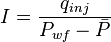
Thus, injection rate could be calculated as:

From Darcy's law for an unfractured injection well located in the center of a circular drainage area, the I in pseudo-steady state is:

Nomenclature
 = formation volume factor, bbl/stb
 = injectivity index, stb/psia
 = dimensionless productivity index, dimensionless
 = permeability times thickness, md*ft
 = average reservoir pressure, psia
 = well flowing pressure (bottomhole), psia
 = injection rate, stb/d
 = wellbore radius, ft
 = drainage radius, ft
 = skin factor, dimensionless
Greek symbols
 = viscosity, cp