Difference between revisions of "Hagedorn and Brown correlation"
From wiki.pengtools.com
(→Workflow) |
(→Workflow) |
||
| Line 49: | Line 49: | ||
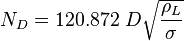
:<math> N_{D} = 120.872\ D \sqrt{\frac{\rho_L}{\sigma}} </math> | :<math> N_{D} = 120.872\ D \sqrt{\frac{\rho_L}{\sigma}} </math> | ||
| − | :<math> H = \frac{N_{LV}}{N_{GV}^{0.575}}\ \left ( \frac{ | + | :<math> H = \frac{N_{LV}}{N_{GV}^{0.575}}\ \left ( \frac{p}{14.7} \right )^{0.1} \frac{CN_L}{N_D} </math> |
| − | :<math> \frac{H_L}{\psi} </math> | + | :<math> \frac{H_L}{\psi} = \sqrt{\frac{0.0047+1123.32 H + 729489.64H^2}{(1+1097.1566 H + 722153.97 H^2}} </math> |
corr p2 | corr p2 | ||
Revision as of 12:26, 21 March 2017
Contents
Brief
Hagedorn and Brown is an empirical two-phase flow correlation published in 1965.
It doesn't distinguish between the flow regimes.
The heart of the Hagedorn and Brown method is a correlation for the liquid holdup : .
.
Math & Physics
Following the law of conservation of energy the basic steady state flow equation is:

where

Colebrook–White equation for the Darcy's friction factor:

Reynolds two phase number:

Discussion
Block Diagram
Workflow


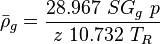


![N_L = 0.15726\ \mu_L \sqrt[4]{\frac{1}{\rho_L \sigma_L^3}}](/images/math/b/2/0/b207fe79b4a4ee53d466e182791ca737.png)



![N_{LV} = 1.938\ v_{SL}\ \sqrt[4]{\frac{\rho_L}{\sigma}}](/images/math/2/f/2/2f2abb2b5e504663beb5ddb87301af09.png)
![N_{GV} = 1.938\ v_{SG}\ \sqrt[4]{\frac{\rho_L}{\sigma}}](/images/math/4/0/c/40cab20a6f3a6a92f320bbff38c696cd.png)


corr p2